

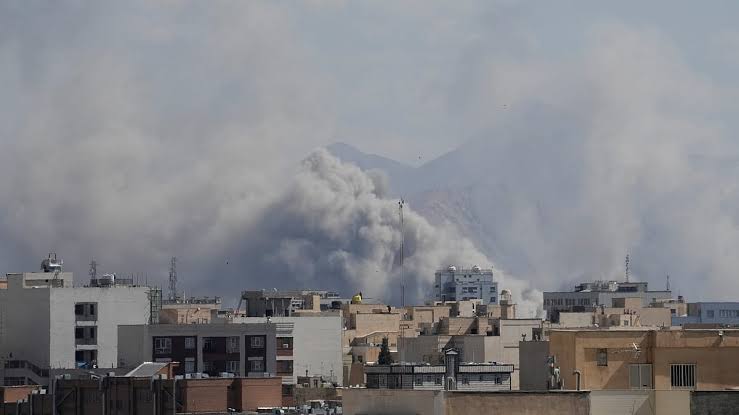
US fighter jets on Tuesday struck a Revolutionary Guards missile launch site on Iran’s Qeshm Island, following Iranian drone attacks on Bahrain—an exchange that underscored the fragility of efforts to de-escalate tensions in the region.
A US military official confirmed that American aircraft employed precision-guided munitions to neutralize the site, framing the operation as a clear act of self-defense.
“The strike was in direct response to IRGC aggression targeting US personnel and assets,” the official stated. “US Central Command remains on high alert and is fully prepared to safeguard Americans across the region.”
Ahmad Nafisi, a local Iranian provincial official, reported that the assault on Qeshm inflicted no harm on residential zones, commercial establishments, or critical infrastructure.
Iranian media outlets indicated that US forces had destroyed an air defense missile launcher in the island’s Nariman district. Tasnim news agency, affiliated with the IRGC, reported that multiple projectiles struck the island.
The US strike unfolded just hours after the Guards claimed they had targeted a US radar system at Bahrain’s Isa Air Base, citing what they described as persistent American drone incursions into Iranian airspace.
The US military asserted that the Iranian drones were intercepted without causing any damage to American hardware or injuries to US personnel.
“Multiple one-way attack drones launched by the IRGC today towards Bahrain were intercepted, with no damage to US equipment or injury to American personnel,” US Central Command posted on X, adding that both US and partner forces remain highly vigilant.
Separately, Iran’s army announced it had downed a LUCAS drone over the Strait of Hormuz using domestically developed air defense systems—a claim the US has yet to address.
Regional condemnation
US Secretary of State Marco Rubio discussed the Iranian attacks with Bahraini Foreign Minister Abdullatif bin Rashid Al Zayani, Bahrain’s Foreign Ministry said. Rubio condemned the attacks and reaffirmed Washington’s commitment to Bahrain’s security and that of its regional partners.
Saudi Arabia called for an immediate halt to Iranian attacks on countries across the region and urged that diplomacy be given a chance. Qatar also condemned the attacks on Bahrain, warning that their continuation marked a serious escalation that undermined efforts to ease tensions.
The Guards, meanwhile, issued a further warning to Bahrain.
Spokesman Hossein Mohebbi accused its government of cooperating in attacks on Iran and relying on a US “security bubble,” saying those policies would cast doubt on Bahrain’s survival in a new regional security order.
The exchange came as Qatar said it would meet Iranian officials to discuss proposals aimed at narrowing differences between Tehran and Washington.
It also followed Iranian Foreign Minister Abbas Araghchi’s visits to Pakistan and Oman, who have long been acting as mediators in Iran-US tensions.
Shipping under threat
The violence also coincided with further reports of vessels being hit around the Strait of Hormuz.
The UK Maritime Trade Operations agency said a vessel sustained a second strike about seven nautical miles north of Khasab, Oman, causing a fire. Its crew were unaccounted for, and the extent of the damage was unknown, the agency said, citing a maritime security agency.
Iran’s Guards Navy separately claimed that a supertanker carrying more than two million barrels of crude and a liquefied gas carrier had struck sea mines in the strait. Iran’s army also reported a mine strike on a tanker east of the waterway.
It was unclear whether the Iranian statements and the UKMTO alert referred to the same incidents.
Iraq’s attempt to reclaim a stronghold of Iran-backed militia could test Baghdad’s authority over armed factions while leaving much of Tehran’s influence over the country’s politics, security forces and economy intact, experts told Iran International.
Baghdad ordered troops on Monday to enter Jurf al-Sakher, south of the capital, following an investigation into suspected oil smuggling. The faction has been given until Friday to withdraw, according to a security source cited by AFP.
The move comes amid US pressure to rein in Iran-backed militias, but taking control of the town would not necessarily dismantle the political and financial networks that sustain their power.
“It’s going to be once again a theatrical show,” said Omar Mohammed, an Iraqi historian who documented life under Islamic State through his blog Mosul Eye.
Senior Iraqi officials told Reuters that Kataib Hezbollah had operated an oil-smuggling network for years, generating hundreds of millions of dollars since 2021. The US-designated terrorist organization, which has attacked American forces in the region, has long controlled Jurf al-Sakher, also known as Jurf al-Nasr, in Babil province south of Baghdad. Kataib Hezbollah denied the smuggling allegations, Anadolu reported.
Why Jurf al-Sakher matters
Mohammed described Jurf al-Sakher as a financial hub Iran has used to evade sanctions. He said the town’s location near roads linking Baghdad with Karbala and Anbar gives whoever controls it strategic leverage over the capital. He also pointed to the displacement of Sunni residents, whose prolonged exclusion has fueled sectarian tensions.
More than 100,000 people from Jurf al-Sakher and surrounding communities remain unable to return more than a decade after Iraqi forces retook the area from Islamic State in 2014, Shafaq News reported. Government committees have entered the area in recent months, but such visits have been unusual and required high-level security and political coordination, the outlet said.
Prime Minister Ali al-Zaidi “ordered the armed forces to enter” Jurf al-Sakher, government spokesman Haidar al-Aboudi told the Iraqi News Agency, adding that “a deadline has been set for the armed faction to exit the area.” A security source told AFP the deadline was Friday.
Al-Aboudi said investigators found evidence of pipeline tampering. Nine security and oil officials were dismissed following the investigation, Reuters reported.
Sources told The New Arab that fighting between Iraqi forces and Iran-backed factions was possible. A senior Iraqi official told the outlet that the government had deployed armored vehicles to the town’s outskirts.