

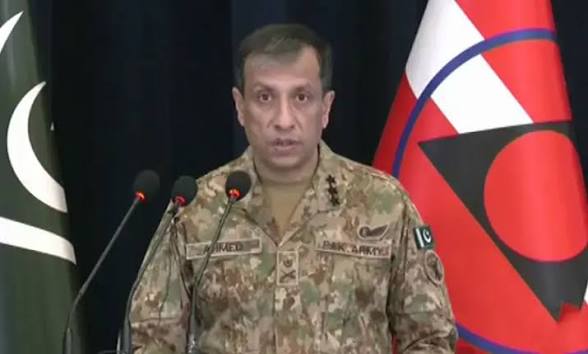
On Friday, the Pakistani military stated that there are intentional efforts to create a perception of a worsening security situation in Balochistan, while emphasizing what it termed as enhanced nationwide counterterrorism operations under the ongoing Azm-e-Istehkam campaign.
These comments were made during a comprehensive press briefing by Inter-Services Public Relations (ISPR) Director General Lieutenant General Ahmed Sharif Chaudhry, who also provided updated statistics on military operations, incidents of terrorism, and casualties recorded thus far in 2026. He reaffirmed that the state would not engage in negotiations with terrorists and promised a resolute response to militancy.
OPERATIONS OVERVIEW
In his presentation regarding the country’s security landscape, Lt Gen Chaudhry reported that security forces have conducted 40,348 intelligence-based operations this year. This number encompasses actions taken by the armed forces, police, civil armed forces, and intelligence agencies.
As per the military spokesperson, over 31,000 operations have been executed in Balochistan, which includes a total of 31,080 operations, while Khyber Pakhtunkhwa saw 7,177 operations. Additionally, operations in other regions of the country amounted to 2,091.
He stated that security forces are currently conducting nearly 200 intelligence-based operations daily, with an average of about 194 per day, indicating a continuous nationwide effort against terrorism.
The ISPR chief reported that 2,084 confirmed terrorists have been eliminated during these operations, averaging approximately 10 militant deaths each day. He characterized this as the highest daily ratio recorded to date, noting that the operational trend signifies an increase in the effectiveness of counterterrorism initiatives.
In a broader context, he mentioned that 2,597 terrorists were killed in 2025. With five months remaining in 2026, he emphasized that the ongoing campaign continues to show advancements in the military’s kinetic operations against militant factions.
TERRORISM INCIDENTS
Lt Gen Chaudhry indicated that Pakistan has experienced 3,145 terrorism incidents this year. Of these, 1,971 incidents occurred in Khyber Pakhtunkhwa, 1,148 in Balochistan, and 26 in other areas of the country.
He noted that there have been 28 suicide attacks in 2026. According to the military spokesperson, most of these attacks involved Afghan nationals, including those connected to recent events in the Tank district of Khyber Pakhtunkhwa and Karachi. He also claimed that individuals linked to Afghan security forces were involved in several of the suicide attacks.
The DG ISPR reported that 819 Pakistanis have become martyrs in terrorism-related incidents this year, averaging about four per day. The casualties included 303 army personnel, 194 police and other law enforcement members, and 322 civilians.
In comparison to previous years, he noted that the number of security personnel and civilians martyred had previously surpassed the number of terrorists killed, but this trend began to shift in 2024.
He further claimed that certain factions were hindering development projects in the province and were targeting laborers to impede progress. He mentioned provincial development funds and asserted that some tribal leaders were demanding a share of public resources, threatening violence if their requests were not fulfilled.
Lt Gen Chaudhry also accused specific Sardars of treating the Levies Force as their own tribal militia and alleged that the smuggling of narcotics and diesel persisted under the pretense of legitimate business activities.
The DG ISPR additionally alleged that the Afghan Taliban regime was backing terrorist groups that operate against Pakistan, questioning the shared interests between Afghanistan, India, and the banned Balochistan Liberation Army (BLA).
Reiterating the state’s stance, Lt Gen Chaudhry stated that there was no possibility for negotiations with terrorists. He emphasized that militants had two choices: either surrender their weapons or face decisive action, noting that terrorists had come to understand that the state would not show leniency in its response.
In discussing political dialogue, the military spokesperson remarked that while some groups often advocated for rights, they should also acknowledge their responsibilities. Citing Article 5 of the Constitution, he stated that loyalty to the state is a constitutional duty and characterized a “hard state” as one where all matters are strictly governed by the Constitution and the law.