

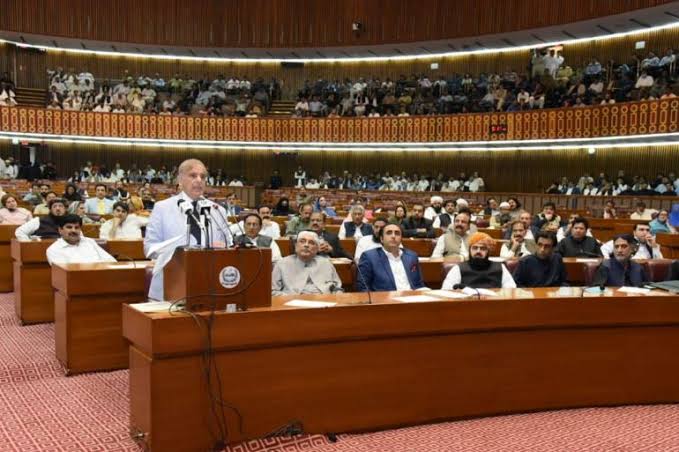
On Thursday, the National Assembly (NA) and Senate approved the National Command Authority (Amendment) Bill 2026 and the Defence Forces Act 2026 with a majority vote, despite the opposition’s boycott of the voting process and their subsequent walkout in protest.
Prime Minister Shehbaz Sharif attended the session and, upon his arrival, approached the opposition benches to greet NA opposition leader Mahmood Khan Achakzai, along with Pakistan Tehreek-e-Insaf chairman Barrister Gohar, Asad Qaiser, and Aamir Dogar.
The government had previously introduced the bills as part of a supplementary agenda, leading to their presentation for approval in the House. The Defence Act, which became effective retroactively on November 13, 2025, established the Defence Forces Headquarters, designated as the central command for the armed forces.
According to the legislation, the Defence Headquarters would serve as the senior military advisor to the prime minister on issues concerning national security, defense, and the armed forces.
The Chief of Defence Forces (CDF) would hold operational command and control over the armed forces and would be accountable to the federal government regarding such command and control.
The legislation granted the CDF the necessary authority for multi-domain integration, operational coordination, liaison, and the joint management and oversight of armed forces matters.
Additionally, the CDF would possess the authority under relevant laws to retire, release, or dismiss personnel, with the exception of those appointed under Article 243 of the Constitution. The CDF would also have the ability to approve or deny resignations, retain personnel in service, and modify the retirement age or the prescribed term of service for individuals.
Furthermore, the Act empowered the CDF to exercise additional powers and fulfill duties as specified by the federal government.
The federal government is responsible for creating rules and regulations to enforce the Act, while the CDF is authorized to issue directives and orders to implement its provisions.
The legislation also stipulated that the president could address challenges arising from the execution of the Act or any discrepancies between its provisions and existing laws.
The National Assembly approved the National Command Authority (Amendment) Bill 2026, which took effect retroactively from November 27, 2025. This amendment replaced references to the Chairman Joint Chiefs of Staff Committee in the Act with those of the Chief of Army Staff and Chief of Defence Forces.
On Thursday, the Senate unanimously approved the Defence Forces of Pakistan Amendment Bill 2026 and the National Command Authority Amendment Bill 2026, despite significant opposition from lawmakers of Pakistan Tehreek-e-Insaf (PTI).
Subsequently, Defence Minister Khawaja Asif introduced the bills in the upper house, where both pieces of legislation were passed unanimously.
Opposition Leader Allama Raja Nasir Abbas raised concerns regarding the process of introducing the bills and questioned the urgency of the legislation.
“What is the emergency? Is this the proper way to conduct legislation?” he inquired.
Abbas mentioned that he had only recently received a copy of the bill and urged the Senate Chairman to allow lawmakers sufficient time to review it.
He declared that the opposition would stage a protest and boycott the House.
Following this, PTI lawmakers stood up and exited the chamber.
Law Minister Azam Nazeer Tarar defended the government’s actions, stating that parliamentary rules permitted the introduction of supplementary legislation.
Tarar challenged the need for further discussion on the amendment.
“Tell me, what mathematical formula necessitates our sitting down to discuss?” the law minister remarked.
He noted that the three armed forces had maintained the same level of coordination during Marka-e-Haq, which he claimed led to Pakistan’s success.
He further stated that the legislation had already been approved by the NA after lawmakers had thoroughly reviewed it “word by word.”
The opposition had objected to the supplementary agenda, with Jamiat Ulema-e-Islam Fazl (JUI-F) lawmaker Aliya Kamran arguing that the opposition had not received copies of the legislation, prompting the law minister to tell lawmakers to “learn to make use of technology”, saying the bills were available on members’ tablets.
Achakzai said lawmakers needed time to examine the proposed legislation. “We are members of this parliament. We want legislation to be carried out,” Achakzai said. “Bring the bills to us. Our colleagues will read them and give their views. At least give us two or three days so that they can be debated.”
He also called for a briefing on Pakistan’s foreign policy and regional developments, referring to US President Donald Trump’s reported warning against countries maintaining economic ties with Iran. “Brief us on what is happening,” Achakzai said.
Turning to PTI founder Imran Khan, Achakzai said, “You have made the founder of the PTI an issue of the heavens. Even the worst criminal has the right to have his health taken care of.”
The opposition benches staged a boycott of the voting process and walked out of the National Assembly in protest.