

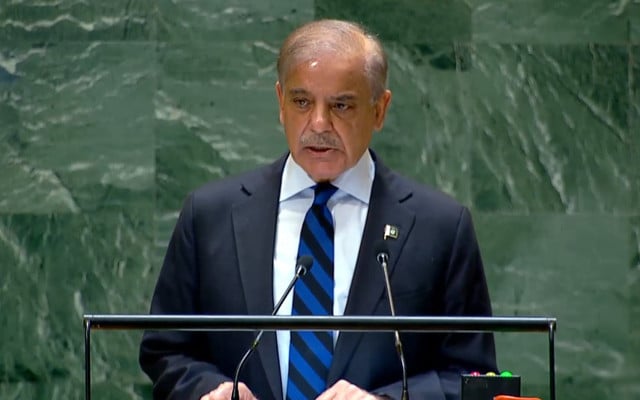
Prime Minister Shehbaz Sharif has appealed for restraint and diplomatic engagement as tensions continue to rise throughout the Middle East, emphasizing that the Makkah Joint Defence Agreement established between Pakistan, Saudi Arabia, and Turkiye is not intended to target any specific nation.
Speaking before the United Nations General Assembly, the prime minister also denounced Houthi assaults on Saudi Arabia and called for the preservation of two vital shipping corridors, namely the Strait of Hormuz and Bab al-Mandab.
PM Shehbaz characterized Pakistan’s dedication to peace as evident in the “historic Makkah Joint Defence Agreement” among the three nations, presenting it as a unified commitment to regional defence, stability, and peace.
“This alliance does not target any country,” he stated. “It represents a collective commitment to defence, stability, and peace in the region and serves no other purpose.”
The agreement was executed by Pakistan, Saudi Arabia, and Turkiye on August 7 and stipulates that member nations must regard an assault on one as an assault on all. Since then, representatives from the three nations have commenced establishing the agreement’s organizational framework, with Pakistan designated to oversee its secretariat based in Riyadh.
The prime minister firmly denounced what he termed “abhorrent” assaults by Yemen’s Houthi militants against Saudi Arabia, noting that the interception of a Yemeni unmanned aircraft above the sacred city of Makkah provoked outrage among Muslims globally.
He affirmed Pakistan’s unwavering support for the Saudi population and reaffirmed Islamabad’s pledge to safeguard the kingdom’s security.
His comments emerged as Saudi Arabia, Pakistan, and Turkiye prepare for a critical gathering of their military leadership in response to the Houthi assaults. The gathering is anticipated to examine strategies for assisting Riyadh under the joint defence agreement’s provisions.
These circumstances have additionally prompted high-ranking representatives from the three nations to deliberate on the formalization of the accord and broader regional security matters.
Prime Minister Shehbaz emphasized the critical importance of maintaining open passage through the Strait of Hormuz and Bab al-Mandab, characterizing these waterways as essential conduits for the global economy.
“The Strait of Hormuz and Bab al-Mandab represent vital economic arteries. These passages must remain accessible, facilitating international connectivity rather than becoming flashpoints for conflict,” he stated.
The prime minister underscored that these waters should facilitate economic growth and stability rather than pose risks of military escalation, while cautioning against the broader implications of intensifying hostilities involving advanced weaponry such as missiles and drones.
The United Nations has independently cautioned that disruptions in the Bab al-Mandab region and ongoing complications affecting the Hormuz Strait could have significant ramifications for international commerce, energy markets, food security, and economies throughout and beyond the Middle East.
PM Shehbaz also underscored Pakistan’s diplomatic contributions following the escalation of Middle Eastern tensions, noting that Islamabad responded promptly by facilitating dialogue between the United States and Iran.
He emphasized that Pakistan had successfully convened Washington and Tehran in Islamabad and referenced the Islamabad Talks and the subsequent Islamabad Memorandum of Understanding as meaningful progress toward conflict resolution.
The prime minister acknowledged the instrumental roles played by Chief of Defence Forces and Chief of Army Staff Field Marshal Asim Munir and Deputy Prime Minister Ishaq Dar in establishing diplomatic opportunities.
During this week’s UN General Assembly, PM Shehbaz engaged with Iranian President Masoud Pezeshkian. He reported that Pezeshkian confirmed Tehran’s continued support for the Islamabad MoU and expressed Iran’s commitment to advancing the agreement.
The prime minister has further emphasized that Pakistan and Iran, as neighboring nations, should collaborate to mitigate regional instability, particularly concerning maritime security in the Strait of Hormuz and the Red Sea.