

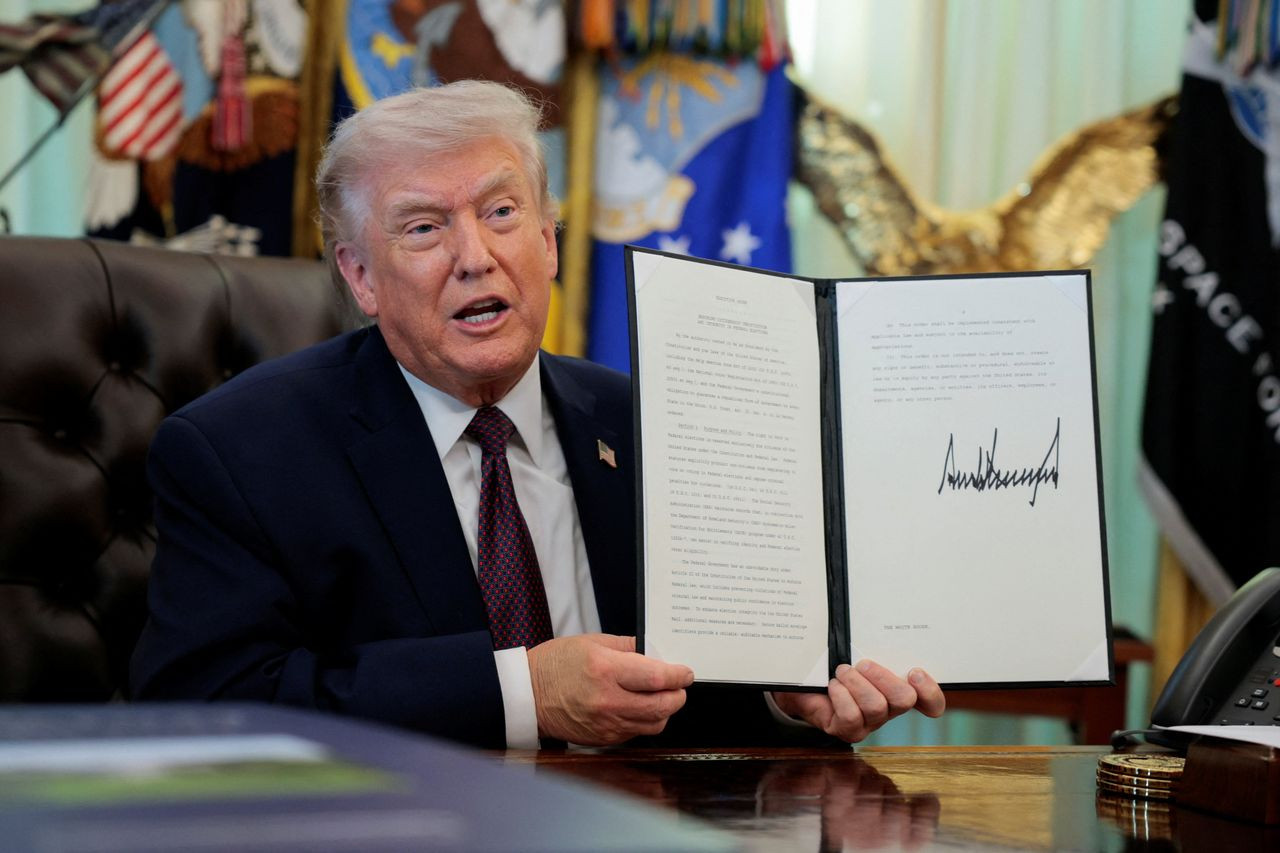
The United States Supreme Court has permitted President Donald Trump to proceed with his executive order that limits mail voting. However, it is uncertain how much his administration can accomplish before the upcoming midterm elections in November.
The ruling on Monday seems to allow for further legal challenges that could delay the implementation of Trump’s order. The court currently has a conservative majority of 6-3, with the three liberal justices dissenting from this decision.
The US Postal Service outlined its plan for implementing the order last week, but time is of the essence as some states are set to begin mailing ballots to voters in just a few weeks.
Mail-in voting has consistently been a target for Trump, who has alleged that it leads to fraud, despite substantial evidence to the contrary and his own use of this voting method.
This case may be one of several voting-related challenges that the justices will address. The US Justice Department submitted an emergency appeal requesting that the Supreme Court permit the implementation of changes before the midterms.
Trump’s executive order, signed in March, instructs his administration to compile lists of eligible voters and mandates that the US Postal Service deliver mail ballots solely to individuals on those lists.
Democratic officials from 23 states and the District of Columbia have filed a lawsuit to prevent the order from taking effect. They contend that the US Constitution grants states and Congress the authority to manage elections, and that Trump’s modifications could result in disorder and partisan manipulation.
“The repercussions of allowing such significant changes to be enacted so close to this fall’s elections would be severe,” the lawyers representing the states stated. Numerous state and local election officials have expressed their concerns, urging the justices to keep the order on hold while election preparations are already in progress.
judge in the US state of Massachusetts blocked the plan for the midterm elections in those states. An appeals court upheld her decision. She later granted a second order blocking it nationwide.
The Trump administration appealed to the Supreme Court on procedural grounds in late July, arguing that the states sued too soon. They also pointed to another ruling out of Washington, where a judge allowed Trump’s order to proceed. An appeals court backed that decision, while still leaving room for future court action if the changes are implemented.
Federal attorneys argued that the Massachusetts order “blocks the government’s ability to finalize and implement the President’s proposed policies to promote election integrity for the upcoming federal elections in November.”
A dozen Republican-leaning states supported the federal government in their own appeal before the high court, saying states would have input on the final voter lists.
The Supreme Court has previously ruled against Trump-backed arguments on mail-in ballots, finding in June that states can count ballots that arrive after Election Day. That case was decided after full briefing and arguments, rather than on the court’s emergency docket.
Trump, who has made false claims of widespread fraud in U.S. elections including his 2020 loss to Democrat Joe Biden, has pressed the Republican-controlled Congress to pass a contentious package of voting restrictions called the SAVE America Act.
He’s also repeatedly pressed for the passage of the legislation that requires proof of citizenship to vote. Noncitizen voting has been shown to be rare, and is a felony that can be punishable by deportation.
Using mail ballots has become increasingly popular with voters of both parties, with about 30 percent of all ballots cast that way during the 2024 presidential election, according to federal data. The process also is secure. A 2025 Brookings Institution study found only about four cases of fraud out of every 10 million mail ballots cast