

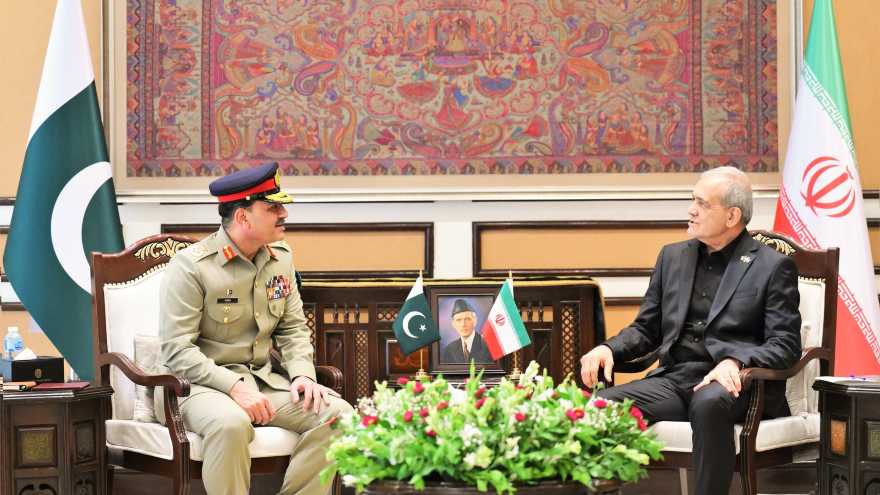
Field Marshal Syed Asim Munir, Chief of Army Staff and Chief of Defence Forces, met with the President of the Islamic Republic of Iran, Masoud Pezeshkian, in a high-level session focused on regional developments and peace initiatives, the Inter-Services Public Relations (ISPR) reported.
During their exchange, both sides conducted a careful review of the evolving geopolitical landscape and the persistent challenges undermining regional stability. The discussion was wide-ranging and candid, centering on the urgent need for coordinated approaches—diplomatic engagement, confidence-building measures and de-escalation—to cool rising tensions and promote negotiated, peaceful solutions amid a complex security environment.
The Iranian president, who is on a day-long visit here, warmly commended Pakistan’s constructive and responsible role in promoting dialogue, de-escalation and regional stability. He acknowledged Islamabad’s sustained efforts to encourage the peaceful resolution of disputes and to foster deeper understanding among regional stakeholders amid a period of heightened geopolitical pressure.
Field Marshal Asim Munir reiterated Pakistan’s unwavering commitment to peace and stability across the region, reaffirming that dialogue and engagement remain central to its foreign policy. The top military commander emphasised the importance of continuous communication between regional partners to manage emerging challenges and to support long-term stability.
Both sides reaffirmed their steadfast commitment to deepening Pakistan-Iran relations, pledging to expand regular consultations on issues of mutual concern and to pursue closer coordination on shared challenges. The discussions underscored a common ambition to advance peace, foster prosperity, and strengthen regional stability through practical cooperation and sustained diplomatic engagement.
The meeting forms part of an ongoing series of high-level exchanges between Islamabad and Tehran, aimed at reinforcing cooperation across political, security, and regional domains as both capitals navigate a shifting geopolitical landscape in the broader region.