

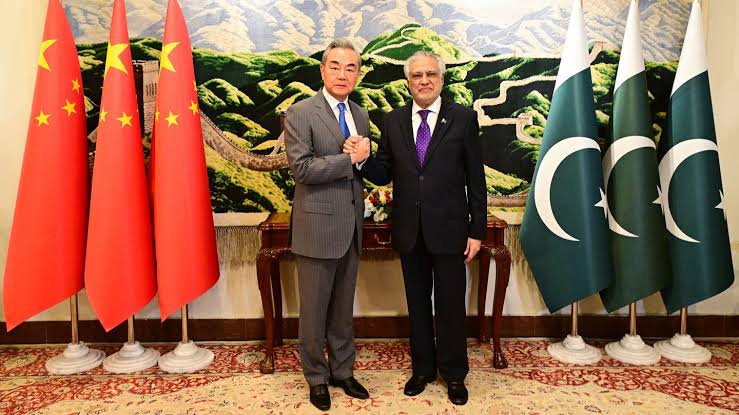
On Tuesday, Pakistan and China announced a five-point plan intended to restore peace and stability in the Gulf and the Middle East as tensions escalate amid the US-Israeli military campaign in Iran.
The plan followed a bilateral meeting in Beijing between Wang Yi, China’s Minister of Foreign Affairs and a member of the CPC Political Bureau, and Pakistan’s Deputy Prime Minister and Foreign Minister, Senator Mohammad Ishaq Dar. The discussions addressed regional developments and actions to avoid further escalation in the Gulf and the Middle East.
Pakistan’s Foreign Office said the two sides set out five main points: an immediate halt to hostilities; launching peace negotiations; safeguarding civilians and civilian infrastructure; securing shipping routes; and respecting the United Nations Charter.
Immediate cessation of hostilities
The first point calls for an urgent stop to military operations and for humanitarian relief to reach all affected regions. Both nations emphasized preventing the spread of the conflict and stressed the need to protect civilians and provide aid to areas devastated by war.
‘The immediate cessation of hostilities and utmost efforts to prevent the conflict from spreading are necessary,’ the statement said. ‘Humanitarian assistance must be allowed to all war-affected areas without obstruction.’
Start of peace talks
Both China and Pakistan called for swift commencement of peace negotiations, highlighting that dialogue and diplomacy remain the only viable mechanisms for resolving the conflict. The statement reiterated that the sovereignty, territorial integrity, national independence, and security of Iran and Gulf states must be respected during these discussions.
“China and Pakistan support the relevant parties in initiating talks, with all sides committing to peaceful resolution of disputes and refraining from the use or threat of force during peace talks,” the statement added.
China’s foreign ministry previously described the process of initiating peace talks in the conflict as challenging but necessary to restore regional stability and normal navigation through the strategically vital Strait of Hormuz.
Protection of civilians and infrastructure
The third point of the initiative focused on civilian protection and adherence to International Humanitarian Law. Both nations urged all parties involved in the conflict to immediately halt attacks on civilians and non-military targets, including critical infrastructure such as energy plants, desalination facilities, power networks, and peaceful nuclear installations.
“The principle of protecting civilians in military conflict should be observed at all times,” the statement noted.
Security of shipping lanes
The Strait of Hormuz, a crucial global shipping corridor for goods and energy, remains a particular concern. China and Pakistan called for ensuring the safe passage of civilian and commercial vessels, the protection of crew members, and the restoration of normal shipping operations through the Strait.
“The Strait of Hormuz, together with its adjacent waters, is an important global shipping route. Parties should protect the security of ships and crew, allow safe passage, and restore normal navigation as soon as possible,” the statement said.
Primacy of United Nations Charter
Finally, the initiative highlighted the need for a multilateral approach, reinforcing the primacy of the United Nations and international law. Both countries urged collaborative efforts to establish a comprehensive peace framework aimed at achieving lasting stability in the region.
“China and Pakistan call for efforts to practice true multilateralism, jointly strengthen the primacy of the United Nations, and support the conclusion of a comprehensive peace framework based on the purposes and principles of the UN Charter and international law,” the statement added.
Earlier in the day, China said it would strengthen cooperation with Pakistan on matters related to Iran. Chinese foreign ministry spokeswoman Mao Ning described the two countries as “all-weather strategic partners” and stressed the need for joint strategic communication and efforts to promote peace.
Senator Ishaq Dar arrived in Beijing late Tuesday afternoon, was received by senior officials, and later met bilaterally with Minister Wang Yi at the Diaoytai State Guest House. The visit was Dar’s second official trip to Beijing in 2026, underscoring the ongoing close coordination and regular consultations between Islamabad and Beijing on regional and international issues.
Iran’s Ambassador to Pakistan, Reza Amiri Moghadam, praised Islamabad’s diplomatic efforts, calling them proactive and motivated by goodwill to restore peace and stability in the region. He emphasized Pakistan’s “good office” in facilitating dialogue to halt US-Israeli military aggression.