

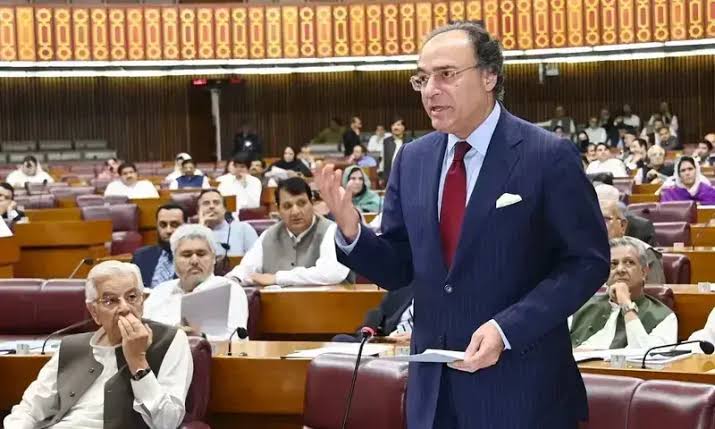
Finance Minister Muhammad Aurangzeb, while presenting the federal budget for fiscal year 2026–27 in the National Assembly on Friday, announced total federal expenditure of Rs18,771 billion and set an economic growth target of 4%, describing the budget as anchored in ‘stabilisation, reform and growth’.
He said Pakistan’s economy expanded by 3.7% in FY2025–26 despite destructive floods and regional tensions, reaching a nominal size of $452 billion. Per capita income, he noted, rose to $1,901, while large-scale manufacturing delivered its strongest performance in four years.
Current expenditure, Aurangzeb said, stood at Rs17.4 trillion, including Rs8,054 billion allocated for mark-up payments and Rs2,680 billion in grants. He highlighted a striking recovery in external buffers: foreign exchange reserves have risen from below $4 billion three years ago to more than $17 billion, now sufficient to cover nearly three months of imports.
Looking ahead to FY2026–27, the minister projected GDP growth of 4%, inflation at 8.2%, a budget deficit of 3.6% of GDP, and a primary surplus of 2% of GDP. He also emphasised gains on the monetary and debt fronts: the policy rate has been eased from 22% to 11.5%, and the debt-to-GDP ratio stands at 68.5% with an improved debt maturity profile.
On revenue mobilisation, FBR tax revenues are targeted at Rs15,264 billion, while non-tax receipts are estimated at Rs5,336 billion. Aurangzeb pointed out that FBR collections climbed from Rs7.2 trillion to Rs13 trillion over the past three years, reflecting stronger enforcement and a broader tax base.
On external financing and capital markets, he noted Pakistan’s return to international markets after four years with $750 million raised via Eurobonds, and the country’s maiden entry into the Chinese market through a well-subscribed Panda Bond. He added that 11 IPOs were launched during the year and that more than 250 companies have begun operating in Special Technology Zones.
Aurangzeb framed the budget as a careful balance of stability and growth, aimed at consolidating recent gains while pushing for structural reforms to sustain momentum.
The finance minister said the government remained firmly committed to an accelerated privatisation drive, arguing that a vibrant private sector will be the engine of future economic growth.
He recalled the high-profile privatisation of First Women Bank and the sale of Pakistan International Airlines (PIA) via a transparent, live-televised auction on December 23, 2025, which mobilised Rs185 billion in proceeds.
“Private sector is going to lead this country,” Aurangzeb told the House, adding that distribution companies (DISCOs), generation companies (GENCOs) and airports are slated for privatisation in the next phase.
Defence, infrastructure and connectivity
Aurangzeb said Rs3 trillion had been allocated to bolster national defence.
He noted that Rs365 billion had been earmarked for highways, railways and ports, highlighting the imminent launch of the Karachi–Rohri section of the ML-1 railway line.
Additional targeted allocations include Rs157.5 billion for highways, Rs100 billion for the N-25 dual carriageway conversion, and Rs30 billion for the M-6 Sukkur–Hyderabad Motorway.
Energy, circular debt and gas sector
The finance minister emphasized that energy remains the economy’s lifeline, announcing that the net accumulation of circular debt has been halted. He said Rs1,091 billion has been earmarked for electricity subsidies and Rs116.2 billion for sustainable energy initiatives. To improve targeting and transparency, a direct subsidy mechanism will be introduced in January 2027.
Aurangzeb added that long-term LNG agreements with Qatar and Italy were renegotiated, cutting 35 cargoes and saving about $1.2 billion. He stressed that gas supply to fertiliser plants has been maintained without interruption: ‘We did not let fertiliser production halt even for a single moment.’
Since March 2024, an additional 100 MMCFD of gas has been brought online. Discoveries from 17 fields produced 108 MMCFD of gas and 16,000 barrels of oil. Offshore exploration has resumed after two decades, with 24 blocks awarded and roughly $1 billion of investment expected.
Tax reforms and relief measures
Aurangzeb announced targeted tax relief for salaried individuals, including a reduction in the primary middle-income tax rate from 23% to 20%. No income tax will be applied to annual earnings up to Rs600,000, while the super tax on income above Rs500 million will be cut from 10% to 8%.
Property withholding tax for filers has been reduced from 5.5% to 2.75%, and the capital value tax on foreign assets has been abolished. Export tax has been lowered from 2% to 1.25% and the Export Development Surcharge removed. The government is also considering removing the super tax on exporters.
Small traders and FBR modernisation
Finance Minister Aurangzeb announced a new, predictable tax arrangement for small retailers: a fixed regime under Section 99B of the Income Tax Ordinance that lets retailers pay a flat 1% tax on their annual sales. The plan promises simplified filing and a minimum payment threshold of Rs25,000, designed to reduce paperwork and bring greater clarity to small-business taxation.
He said compliant traders will receive a visible “green slate” status — a recognition that, in return for meeting their obligations, tax officials will refrain from routine inspections of their premises. Aurangzeb added that the FBR’s broader reforms will modernize tax administration through a National Faceless Centre, AI-driven systems, and the integration of third-party data from property, vehicles and banks. Production monitoring systems have already been installed in the cement and sugar sectors to improve transparency and oversight.
Industrial development and SEZ expansion
The finance minister revealed that 6,860 acres of Pakistan Steel Mills land will be transformed into a Special Economic Zone to attract fresh investment and generate employment. He also highlighted the establishment of industrial design and automation centres in Karachi, Lahore and Sialkot, and noted that Rs88 billion has been allocated to bolster the Export Refinance Scheme.
IT, digital economy and governance
Aurangzeb reported a 20% rise in IT exports, reaching $4.5 billion, and announced plans to launch 5G services in five cities. He said 92% of remittances now arrive through formal bank channels, while digital merchant integration has surged from 500,000 to 1.67 million merchants. Finally, he pointed out that 39,000 companies are now registered with the SECP, a sign of renewed business activity and confidence.
Social protection and human development
Aurangzeb reported that Rs71 billion has been earmarked for the Prime Minister’s Apna Ghar scheme and Rs54 billion for a range of low-cost housing programmes designed to shelter vulnerable families. He said the Benazir Kafalat Programme will extend cash support to 12 million households, while the Benazir Taleemi Wazaif will reach 9.2 million children with education grants. He also announced higher-education scholarships totalling Rs46 billion and Rs22 billion set aside for Daanish Schools, aiming to expand opportunities for talented students from disadvantaged backgrounds.
He noted that 68% of Pakistan’s population is under 30 and described youth development as a top national priority. Under NAVTTC, 515,000 young people have been trained, with a 53% employment success rate that points to growing labour-market absorption of trained youth.
Climate challenges and external vulnerabilities
The finance minister warned that recent floods inflicted losses of Rs822 billion, a stark reminder of Pakistan’s acute vulnerability to climate change and water stress. He said the country has been bolstering its global economic standing through renewed access to capital markets and rising investor confidence. ‘Pakistan’s image has improved significantly and its voice is being heard internationally,’ he added.
Aurangzeb also emphasized Pakistan’s diplomatic role in the region during recent tensions and reaffirmed that Pakistan-China relations remain a ‘key pillar of economic stability’. In closing, he expressed gratitude to the prime minister, coalition partners, the opposition, provincial governments and the military leadership for their support in pursuing economic stabilisation and reform.