
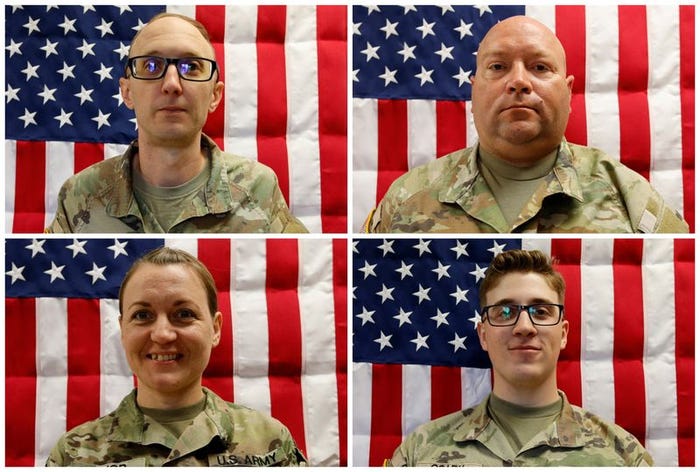
The US military has confirmed the identities of all six soldiers killed in the conflict with Iran.
They died when an unmanned aircraft system evaded air defences and struck a command centre in Port Shuaiba, Kuwait, on Sunday.
US Central Command initially said three soldiers had died in the attack, but officials confirmed on Monday that the death toll had doubled after one person succumbed to injuries and two more bodies were found in the rubble.
Those killed were Chief Warrant Officer 3 Robert M Marzan, 54; Maj Jeffrey R O’Brien, 45; Capt Cody Khork, 35; Sgt Noah Tietjens, 42; Sgt Nicole Amor, 39; and Sgt Declan Coady, 20, who was posthumously promoted from specialist.
The six identified by the Pentagon were members of the Army Reserve, which, according to its website, provides logistical support to broader U.S. military operations.
Four were identified on Tuesday, while the identities of the last two—Marzan and O’Brien—were disclosed on Wednesday.
“These men and women all bravely volunteered to defend our country, and their sacrifice will never be forgotten,” U.S. Army Secretary Daniel Driscoll said in a statement.
White House Press Secretary Karoline Leavitt said on Wednesday that President Donald Trump intends to attend “the dignified transfer of these American heroes” to stand in grief alongside their families. She added that the Defense Department was scheduling the repatriation of the remains.
Khork had previously deployed to Saudi Arabia, Guantanamo Bay, and Poland. The Florida resident had wanted to serve in the military from a young age and enlisted in the Reserve Officers’ Training Corps (ROTC) program at his university, his family told the Associated Press.
Khork was “truly the life of the party, known for his infectious spirit, generous heart, and deep care for those who served alongside him and for everyone blessed to know him,” his mother Donna Burhans, father James Khork, and stepmother Stacey Khork said in a statement.
Amor, of Minnesota, had previously deployed to Kuwait and Iraq. “She was almost home,” her husband Joey Amor told the AP. “You don’t go to Kuwait thinking something’s going to happen, and for her to be one of the first – it hurts.”